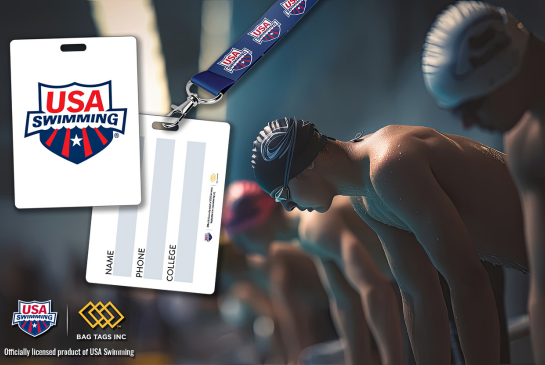
Swim Bag Tags That Turn Every Meet into a Keepsake

Swimmers remember the big relay wins and best times.
What usually sticks around longer, though, is what rides on their bag.
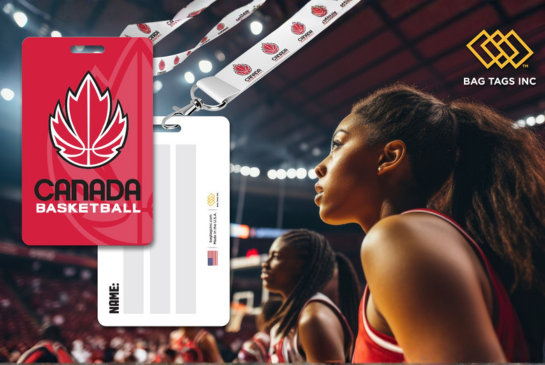
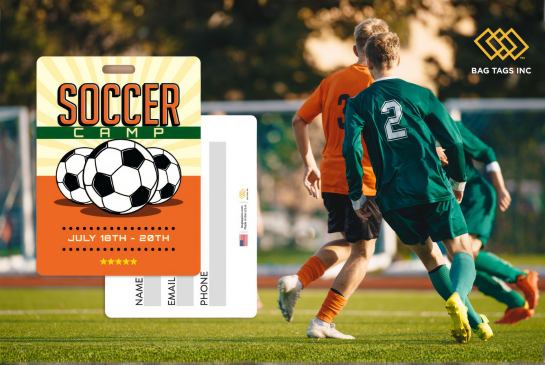
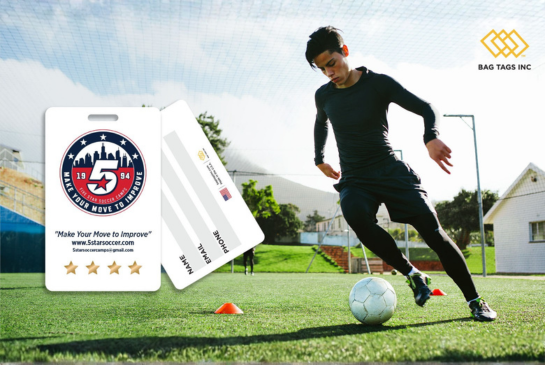
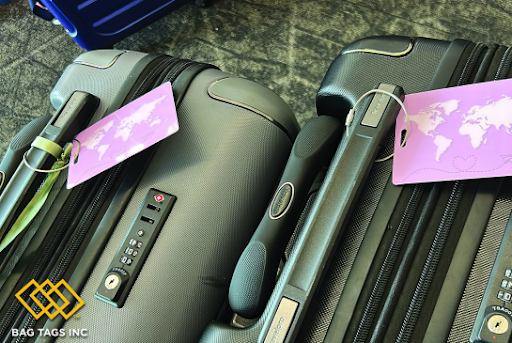
Swim bag tags are custom luggage tags that carry a meet name, year, and team identity long after the last event finishes. They clip onto backpacks, mesh gear bags, and travel duffels, and they stay there for seasons as a small badge of pride. At the same time, they still help families spot bags quickly and make it easier for a lost bag to find its way home.
Bag Tags has nearly 30 years of experience in sports, building luggage tags that balance function with keepsake value for tournaments, leagues, and travel events.
In this guide, you’ll learn how to turn simple swim luggage tags into memorable keepsakes while still getting the everyday function your team depends on.
Why Swim Bag Tags Have Become A Favorite Meet Keepsake
In youth and amateur sports, very few athletes go home with a trophy. Nearly everyone goes home with a bag.
Custom luggage tags are an easy way to mark that season or event in a way that actually gets used. Our experience in sports shows that a well-designed luggage tag often stays on an athlete’s bag for years, long after the original event.
For swim programs, that means one tag can:
- Celebrate a specific invitational, championship, or travel meet
- Show team or school identity in a durable, daily-use format
- Help swimmers and parents quickly spot the right bag in a crowd
- Give a finder a simple way to contact the family if a bag goes missing
What it does not need to do is control access to the pool deck or secure a restricted area. If you want something that acts like an ID badge, controls where people can go, or signals a specific security status, that is the job of an event credential paired with a lanyard, not a luggage tag.
Think of swim bag tags as small, rugged souvenirs that happen to be very practical.
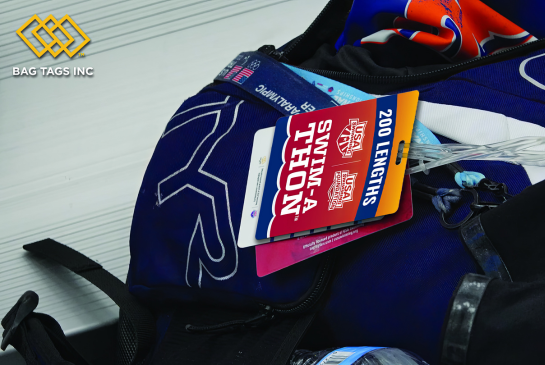
Where Swim Bag Tags Live During And After The Meet
Before you design anything, decide where this keepsake will spend most of its time.
Common homes for swim bag tags:
- Everyday practice backpacks
- Mesh equipment bags (fins, paddles, snorkels)
- Parkas and warmup coats
- Travel duffels and suitcases for championship trips
- Coaches’ and managers’ gear bins
See Bag Tags In Athletics Programs
Ask two questions for each bag type:
- Will this bag be used daily after the event?
- If yes, prioritize designs that feel timeless, not tied only to a single weekend.
- Will this bag see airports, buses, or storage rooms?
- If yes, prioritize tougher loops and slightly simpler layouts that read fast under stress.
Bags that live in the team area at local meets can carry more playful artwork and event-specific details. Bags that go on planes or team buses still celebrate the event, but benefit from cleaner layouts and more durable hardware.
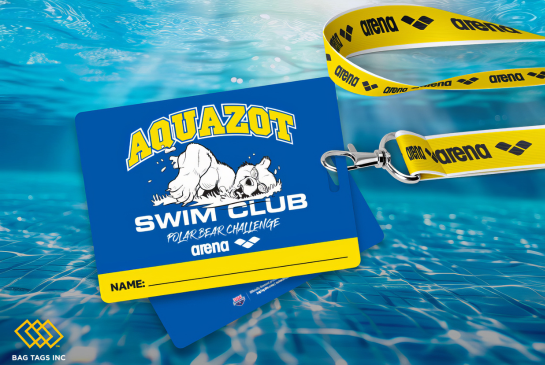
Design Swim Bag Tags That Look Great On Deck And On The Bus Home
A swim bag tag has to work in two places: on a crowded pool deck and in real life after the meet. The most successful designs lead with clarity, then layer in event story and style.
Key design principles:
Make one line dominant.
Use the largest type for either the last name, nickname, or event name, depending on your goal. For most youth and high school teams, the swimmer’s name gets top billing.
Use high-contrast color.
Dark text on a light stripe or light text on a dark bar is easier to read across the deck and in photos from the stands.
Stick with simple, bold fonts.
Clean sans-serif fonts with solid strokes stay legible under bright lights, mixed shade, and a little motion.
Protect the event mark.
Keep the meet logo or host club logo in a consistent corner so it reads clearly without crowding the name.
Test at real size.
Print a proof, hold it at arm’s length under strong indoor light, and ask, “Can I read this without squinting?” If not, increase type size or contrast before you approve anything.
The goal is a layout that still feels special, but never sacrifices readability just to fit one more line of copy.
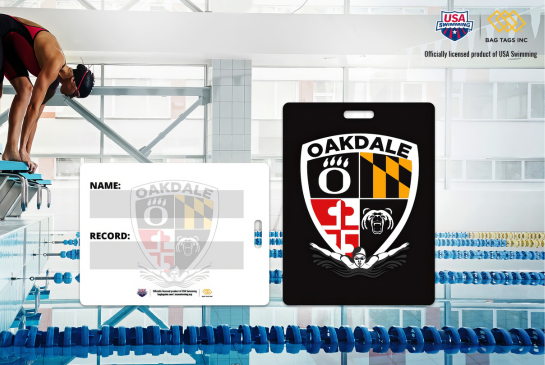
What To Print On The Front vs. The Back
A good swim bag tag tells a story on the front and handles practical details on the back.
A common split:
Front (story and identity)
- Meet or season name and year
- Swimmer’s last name or nickname in large type
- Team, club, or school logo
- Optional short label such as “Sectionals Team”, “Summer League All-Stars”, or “Travel Squad”
Back (recovery and reference)
- Parent or guardian phone number
- City and state (or city and country for international travel)
- Optional email address
- A QR code that links to a simple recovery or event info page
- A brief line such as “If found, please text”
Guidelines that keep swimmers safe and parents comfortable:
- Avoid full home addresses on the outside of a tag.
- For minors, use a guardian contact instead of the swimmer’s direct phone or email.
- Keep printed personal data light and use the QR code for any details that might change.
The front sells the memory. The back quietly supports real-world use.
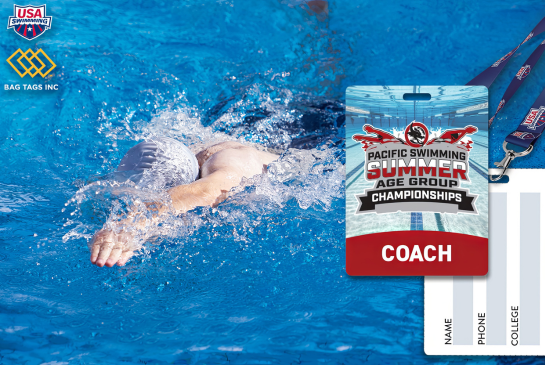
Finish Choices Around The Pool: Glossy vs. Matte
Bag Tags focuses on durable plastic luggage tags in two finishes: glossy and matte. Both are fully water and weather resistant, so your decision is mainly about look and readability in your environment.
Matte swim bag tags
- Cut glare under strong indoor lights or bright outdoor sun
- Hide small scuffs from benches, bleachers, and gear bins
- Feel more “working gear” for daily practice and coaches’ bags
Glossy swim bag tags
- Make team colors and mascots pop for photos and social posts
- Wipe clean quickly after travel or damp conditions
- Feel more like a gift item for welcome packs, travel squads, and banquet favors
Many programs pair them:
- Matte for practice bags and coach equipment that sees heavy use
- Glossy for special events, senior gifts, and travel meet kits
Both finishes work well with the standard luggage tag formats on the Bag Tags Luggage Tag product page, which is where most swim projects start.
Browse Swim Luggage Tag Options
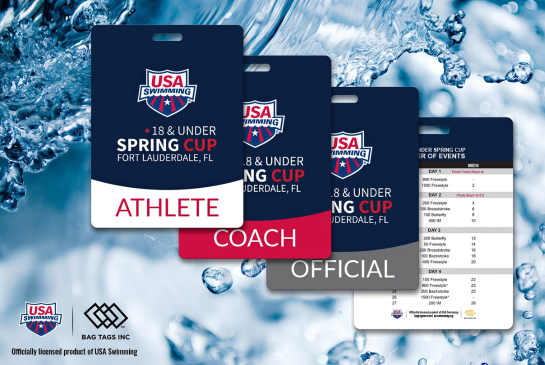
Loop Types: Match Hardware To Swim Life
The loop you choose often decides whether a tag stays on for one season or several. Bag Tags offers two core loop types for luggage tags, plus separate lanyard and credential options when you need true ID badges.
Clear plastic loops
- Flexible and fast to install, even when you are kitting hundreds of tags
- Ideal for backpacks, mesh bags, and parkas
- Best for personal gear that usually stays with the swimmer and does not ride on airport conveyor belts
Premium stainless steel loops
- Built for stress, twisting, and repeated handling
- Recommended for suitcases, hard cases, coaches’ bins, and team trunks
- Use a threaded closure that resists bending and accidental opening
A simple pattern covers most swim programs:
- Clear plastic loops for everyday practice bags and local meet gear
- Stainless steel loops for travel luggage and shared staff equipment
If you need something worn around the neck to control access or identify staff in restricted zones, choose event credentials with lanyards rather than trying to make a luggage tag serve as security.
QR Codes That Extend The Event
QR codes turn a plastic swim bag tag into a small gateway to your event story. Instead of printing long blocks of text, you can send families and swimmers to a page that stays current after the meet.
Popular QR destinations for swim events:
- A meet information page with warmup times, parking notes, and facility rules
- A live results or meet mobile link
- A photo gallery or highlight reel from the weekend
- A sponsor landing page that thanks partners and offers a simple promotion
- A basic recovery form that sends a message to the team or athletic office
Printed QR codes are ideal around pools and on travel bags because they work with any modern smartphone camera and cannot “turn off” the way tap-based devices can.
Tips for reliable scanning:
- Place the code on a solid, high-contrast field away from busy art
- Give it breathing room so the camera can lock on quickly
- Test scans on multiple phones at arm’s length, under bright light, and with a few fingerprints on the tag
Use QR codes for information and recovery. If you want to manage access levels or staff check-in, route that to a credential program instead of expecting a luggage tag to act like a pass.
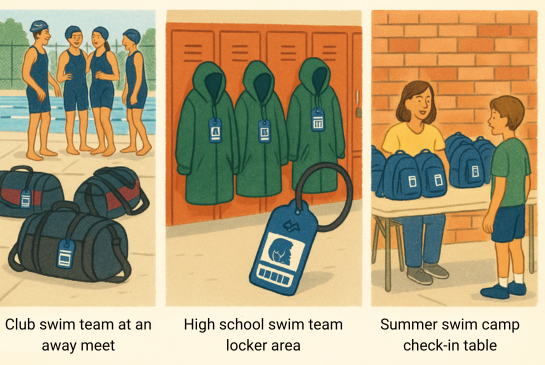
Swim Bag Tags For Different Types Of Programs
Every swim program handles gear a little differently, but the keepsake role stays the same. Below are patterns that help you design once, then adjust details for each group. To see how custom bag tags fit into a complete gear setup for sports programs, visit our athletics bag tags page.
Club Teams And USA Swimming Travel Programs
For club teams and USA Swimming travel squads, swim bag tags work as both a trip marker and a long-term ID tag.
Design ideas:
- Use color bands or stripes to separate squads or training groups
- Keep the club logo in a consistent spot so every bag still feels like part of one team
- Feature the meet name and year in a way that still looks good later, such as “Sectionals Team 2025” rather than only the host city
On the back:
- Point the QR to travel details, a simple itinerary page, or a results hub
- Use stainless steel loops on checked luggage and shared equipment cases
- Use matte finish on working coach kits and glossy on special travel squads or recognition runs
School-Based Teams
For middle school, high school, and college swim teams, tags help unify athletes across multiple seasons.
Front ideas:
- School name or mascot in a prominent spot
- Swimmer name with class year as a secondary line, such as “Taylor Reed • Class of 2026”
- A small mark that distinguishes boys, girls, or combined squads if needed
Back ideas:
- QR link to the athletic department contact page or a simple team information page
- Short text that directs finders to contact the school if a bag is lost
You can also use color or accent stripes to separate varsity from junior varsity so coaches can sort gear at a glance.
Camps And Clinics
Camps and clinics often need tags that volunteers can read quickly on check-in tables, but that swimmers will still keep once the week ends.
Design tips:
- Make the swimmer name very large and easy to read from several feet away
- Use short labels for lane, group, or session so they stay clear even when printed small
- Add the camp or clinic name and year so the tag becomes a natural souvenir
- Reuse the same base layout each session, updating dates, colors, or group labels only
On the back, a QR code can lead to a camp information page, photo gallery, or post-event survey that families can access after they return home.
Plan Swim Bag Tags Around Seasons, Not Just Single Meets
Even when you are focused on one event, it helps to think in terms of a full season of memories.
Start by deciding what each tag should “remember”:
- A single championship or invitational
- A whole summer league season
- A travel team year
- A camp or clinic series
Then treat the swim bag tag as a structured row in your roster spreadsheet. For larger orders, build a clean file with columns for:
- First name
- Last name
- Optional nickname
- Squad or group label
- Graduation year (for school teams)
- Any code or QR destination that needs to change by group
Bag Tags can work from clean CSV files for personalization on larger runs, which makes it easier to produce consistent swim bag tags for an entire program.
Before final approval, always print at actual size, hold the tag at arm’s length, and scan the QR from several angles in bright light. If the name reads easily and the code scans cleanly, you are ready for real deck and travel use.
Align Swim Tags With Your Roster
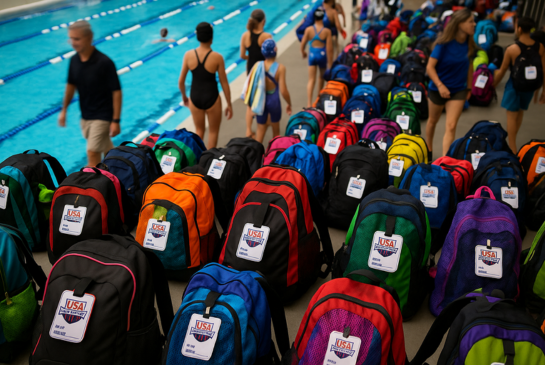
Step-By-Step: Ordering Custom Swim Bag Tags
When you are ready to roll out custom swim bag tags as event keepsakes, this checklist keeps things simple:
- Confirm quantities.
- Count swimmers by squad, age group, or program.
- Add a small buffer for late adds, lost tags, or staff.
- Choose a luggage tag format.
- Start from the Bag Tags Luggage Tag product page and pick a size and shape that suits backpacks and duffels.
- Pick finish and loop type.
- Matte works well for high-glare decks and hard-working gear.
- Glossy suits travel teams, recognition kits, and banquet gifts.
- Clear plastic loops for personal bags, stainless steel loops for checked or shared gear.
- Lock a master layout.
- Fix type sizes, logo placement, and QR code location so you can reuse the same system every season.
- Prepare personalization data.
- Build a clean spreadsheet with the exact fields you plan to print.
- Scan for very long names and agree ahead of time on how to handle them.
- Approve a full-size proof.
- Test readability under bright light.
- Scan the QR from several phones.
Once the first run is complete, keep that layout as your template. Future championship teams and camp sessions become simple reorders instead of new projects.
Start Your Custom Swim Bag Tag Order
Frequently Asked Questions About Swim Bag Tags
What should I print on a swim bag tag?
Most swim programs print the swimmer’s last name or nickname in large type on the front, plus the team or school logo and a meet or season name. On the back, they add a parent or guardian phone number, city and state, and a QR code that links to a simple recovery or team information page. Full home addresses are not recommended.
How are swim team bag tags different from regular luggage tags?
Swim team bag tags share the same durable plastic construction as many luggage tags, but they are designed specifically for pool life and event memory. They often carry meet names, season years, or travel squad labels and are built to handle wet conditions, bleachy decks, and frequent trips to the pool. Many also include QR codes that point to meet information or results.
Are swimming bag tags water safe?
Yes. Bag Tags focuses on printed durable plastic tags in glossy or matte finishes, and both are designed to handle water, condensation, and typical pool conditions. As with any printed item, avoid harsh cleaners or abrasive scrubbing directly on printed areas.
Can I use swim bag tags for USA Swimming championship travel?
Yes. Many clubs use custom luggage tags on checked luggage, team duffels, coaches’ equipment cases, and shared items for USA Swimming travel meets. Stainless steel loops are recommended for any bag that will travel in cargo or be handled repeatedly by staff and volunteers. The tags act as both travel ID and a lasting reminder of the trip.
How many swim meet bag tags does a team need?
A common starting point is:
- One tag per swimmer for their main practice or meet bag
- One tag per travel bag for championship or travel meets
- Additional tags for coaches, managers, and shared equipment bins
Larger programs often keep a small reserve for new athletes, replacement tags, or special recognition such as senior year designs.
Can luggage tags be used for security or access control?
Luggage tags are excellent for identification and keepsake value, but they are not the right tool for controlling access to the pool deck or secure areas. For that, you should use event credentials paired with lanyards, which can display roles, zones, and security details in a larger format. Use luggage tags for bags and memories, credentials for people and access.
How do I get started with swim bag tags for our next event?
Begin with your roster and event calendar. Decide which meets, travel trips, or sessions should have a commemorative tag, then choose a luggage tag format, finish, and loop type that fits your gear and budget. From there, you can work with Bag Tags using templates, proofs, and a clean personalization file to bring your design to life.